The Company Policy about AI and Appraising

As several articles have been published recently in high-profile publications raising questions about the use of AI in appraising, we wanted to take the opportunity to share our company philosophy about this issue.

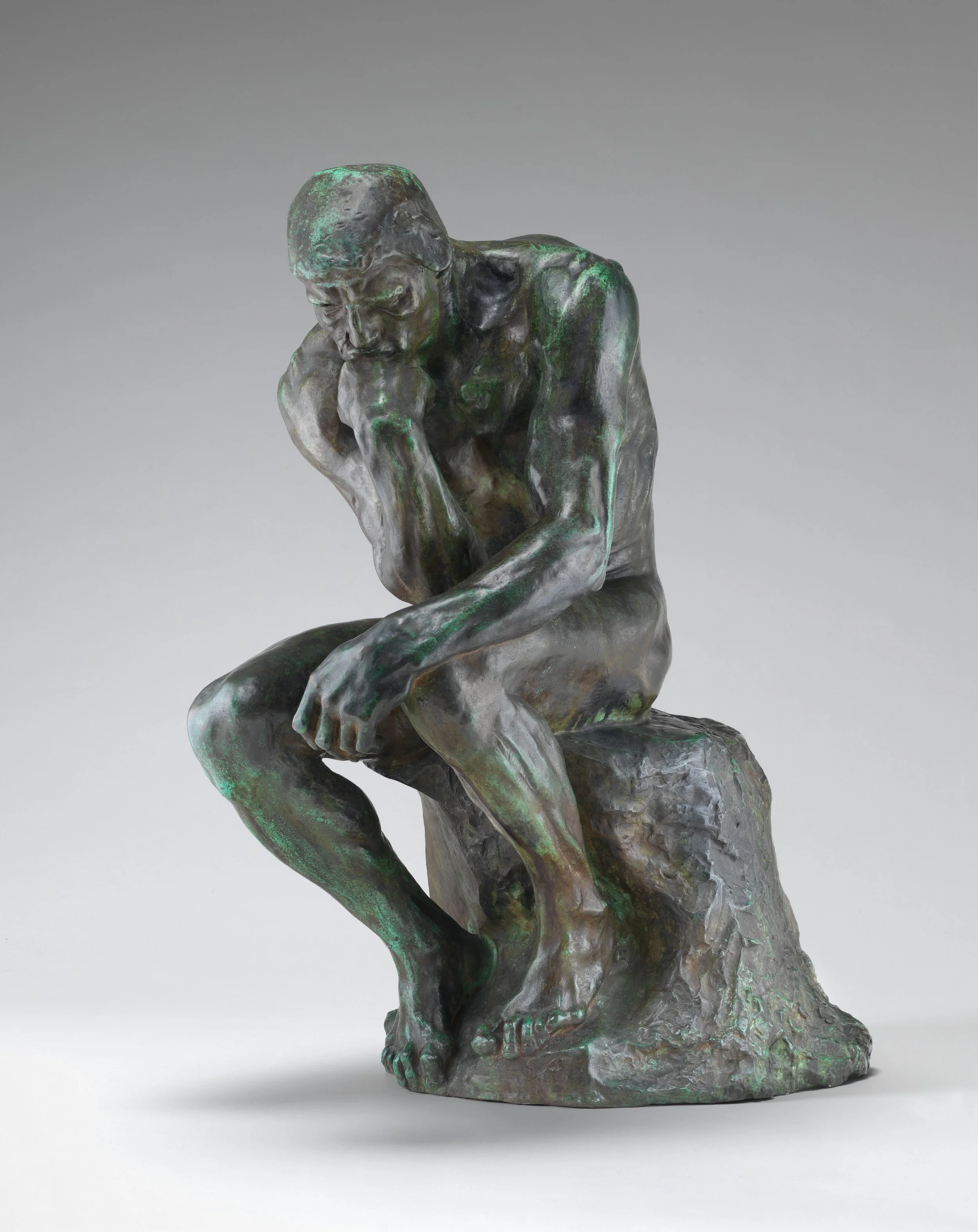
Auguste Rodin, The Thinker (Le Penseur) model 1880, cast 1901

Auguste Rodin (French, 1840-1917), “The Thinker (Le Penseur),” bronze, modeled 1880, cast 1901, in the collection of the National Gallery of Art, Accession Number 1942.5.12, Public Domain Image

We choose to not use AI in our appraisal work for a number of reasons.  We take our professional responsibilities very seriously.  Our clients can rest assured that each appraisal report has been researched and written by us personally, drawing on our years of specialized training and connoisseurship. 

There are many deeply problematic qualities about AI which are especially troubling in the context of its misapplication to appraising.  To highlight just a few of the many issues:

-AI has been known to “hallucinate” and invent things that don’t exist or are incorrect.

-AI has been shown to plagiarize from scholars and other sources without proper attribution and draw from copyrighted material whose use is still being litigated in court.

-The Uniform Standards of Professional Appraisal Practice (USPAP) has a rule called the Record Keeping Rule which requires appraisers to create and maintain a client workfile for each appraisal for a minimum of 5 years. Among the workfile’s contents must be included “all other data, information, and documentation necessary to support the appraiser’s opinions and conclusions and to show compliance with USPAP, or references to the location(s) of such other data, information, and documentation.” (USPAP 2024 Edition, page 12).  That isn’t possible when using AI.

-Use of AI in the creation of appraisal reports for clients has the potential to expose confidential information about their collections, adding it to the larger data set that AI draws on, and risking that confidential specific details of client artworks could potentially become public in the future if used in subsequent AI generated results.  This would be a violation of our fiduciary duty of confidentiality to our clients.

An appraisal report is a document with potential legal and tax implications.  Appraisers have to be prepared to defend their appraisal report in court if needed.  Many other professions are facing similar peril. For example, there are already numerous hair-raising articles detailing many instances where a lawyer’s use of AI has gone terribly wrong.  This has led to grave professional consequences, such as generating footnotes citing imaginary case law that were thrown out in court and penalties issued to the lawyers who used AI.

Most of all, the data sets we work with as appraisers are inherently complex and often flawed, and they require our critical analysis and many years of specialized connoisseurship training about art and the emotional and psychological drivers in the art market to interpret correctly.  Human discernment is needed to appraise art and antiques. 

Furthermore, many crucial details in our appraisal research do not exist in any data set that AI could draw on.  They exist in human relationships, conversations with gallerists and specialists, and details shared verbally about private sales that never entered any record AI could pull from.  This extensive research is part of the expert professional service our clients receive when they work with us to prepare their appraisal reports.

In full disclosure, one exception is we do use Google reverse image searches in our research, which is a tool that pre-existed AI, although it has recently had AI integrated into it.  In some instances Google reverse image searches can be a helpful tool if critical analysis is later applied to review results, such as trying to identify the artist of an illegibly signed print.  As the print is a multiple existing in numerous examples, a Google reverse image search could help find another example of the print that may have the artist’s name included in the description.  This is the only way we use this technology.

Anyone who has received an email from us can be confident that one (or often both) of us wrote it.  We consider it a form of respect to our clients that we take the time to communicate personally with them, and we would not ask our clients to take their valuable time to read something we haven’t ourselves haven’t taken the time to compose.  This is part of the customer service we provide.

We also are cognizant of the intense energy use AI requires and for environmental reasons we also do not want to waste precious resources.

We have also recently seen claims printed in major news outlets suggesting that any appraiser who also works in multiple capacities in the art world such as simultaneously being a gallerist or art advisor is not neutral and this reflects negatively on their appraisals.  There is absolutely nothing wrong with working in multiple roles in the art world and this can provide a helpful perspective about the art market.  The important detail is that an appraiser is only appraising the items being appraised, and not mixing their roles in any other capacity with those same items.  This is well understood in the appraisal field and is a central directive of the guidance provided by USPAP, IRS, and the major professional societies for appraisers.

An additional misleading claim is that it’s unique and exceptional for an appraiser to only appraise without other professional roles, and thus the rest of the community of appraisers are not neutral.  As it so happens, we primarily appraise.  It’s quite common that appraisers just appraise.  We welcome inquiries from journalists who plan to write about this topic, and encourage them to reach out to us and many of our fellow appraisal colleagues so that future articles can reflect accurate information.

Welcoming Patrick McIntyre as Lead Appraiser and Head of our New York and Philadelphia Offices!

I'm thrilled to welcome Patrick McIntyre to Artifactual History Appraisal as Lead Appraiser and Head of our New York and Philadelphia Offices!  Patrick's expertise spans a variety of sectors of the art market and appraisal practice. In addition to appraising, he will focus on bringing in new business, appraisal review, and expanding the scope of services offered by the firm. Prior to joining Artifactual History, Patrick managed membership and admissions for the Appraisers Association, one of the world's foremost professional societies and credentialing institutions for appraisers of fine and decorative art. He also previously served as Manager of Membership and Museum Operations at the Noguchi Museum. Patrick has an MA from NYU, a BFA from Tyler School of Art, Temple University and is USPAP compliant through January 2026. 

You can reach out to Patrick to discuss New York and Philadelphia appraisals at pmcintyre@afhappraisal.com  

I'm so excited to have him on the team!  

The Art Elevator Episode #47: Appraising African Fashion with Makeba Boateng

It was a delightful experience interviewing Makeba Boateng, APR of Boaten Appraisal Service about appraising African fashion on The Art Elevator Podcast! Larissa Wild and I are excited to share her radiant personality and deep expertise and passion for African fashion with you all! I especially enjoyed Makeba's comments about sustainability in African fashion, which helped shift my thinking about how I can be more sustainable in my choices going forward.

Anyone who wants to immediately brighten their day (which is all of us, right?), please go watch our latest episode and be inspired by Makeba! We want to extend a big thank you to our episode sponsor Appraisal Scribe - thank you Lydia Thompson for supporting the podcast and helping us share insights from experts in the appraisal and art world!

Samara Interiors Installation at the Washington Design Center Holiday Fete

Photograph of me by Kaz Sasahara for the Washington Design Center

This month I had the pleasure of attending the Washington Design Center's Holiday Fête in support of my dear friend Samara Goodman, head of Samara Interiors LLC. Samara created a beautiful holiday design installation in the DC showroom of STARK Carpet cleverly incorporating the Holiday Fête theme of "Parisian Holiday." In full disclosure, I had the gift of being able to do creative director-style brainstorming and advising about historical accuracy details with Samara in the process of developing her design concept (thank you for letting me have an insider's view of this Samara!) so now I get to share with you all the genius of her vision!

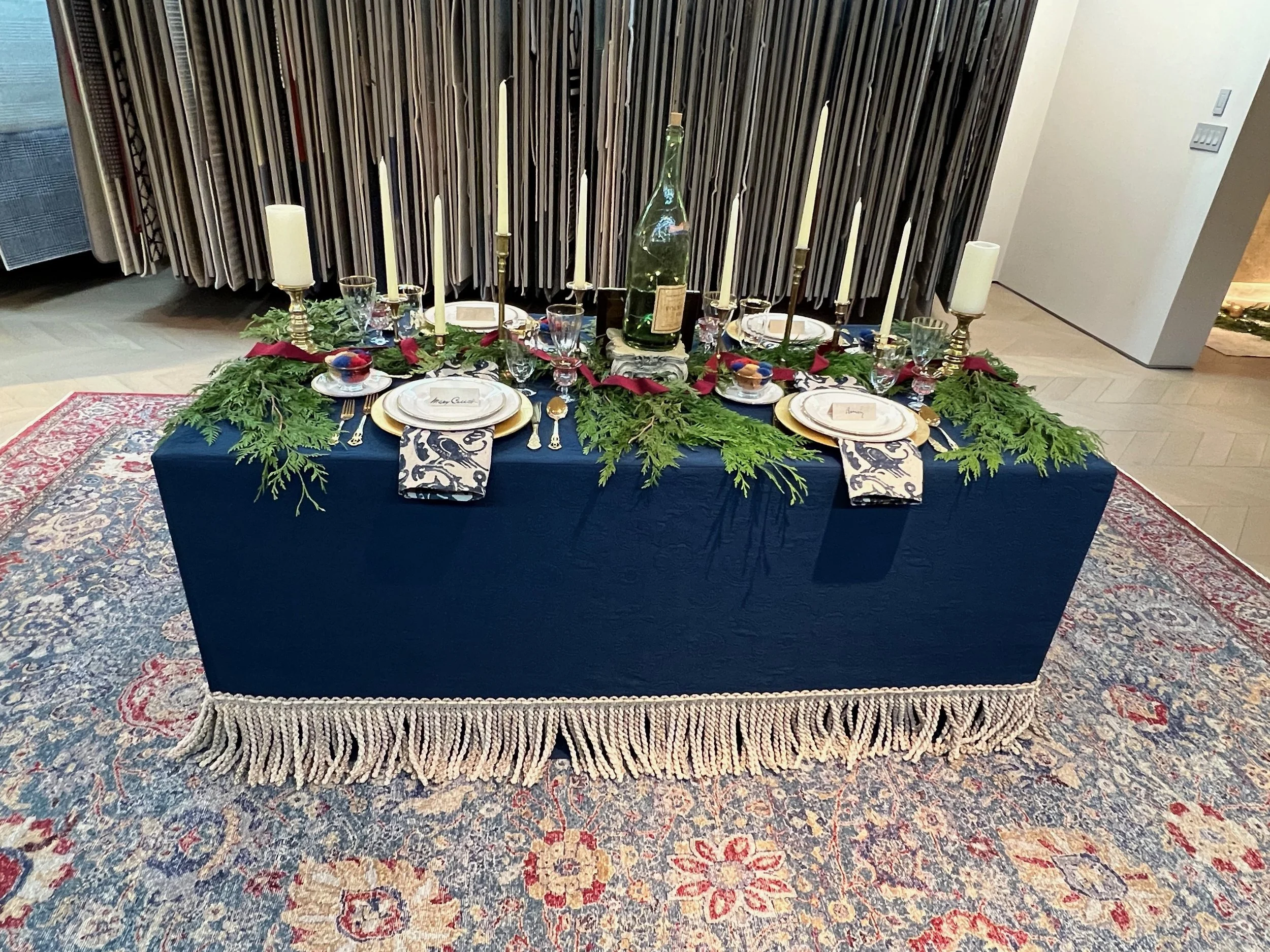
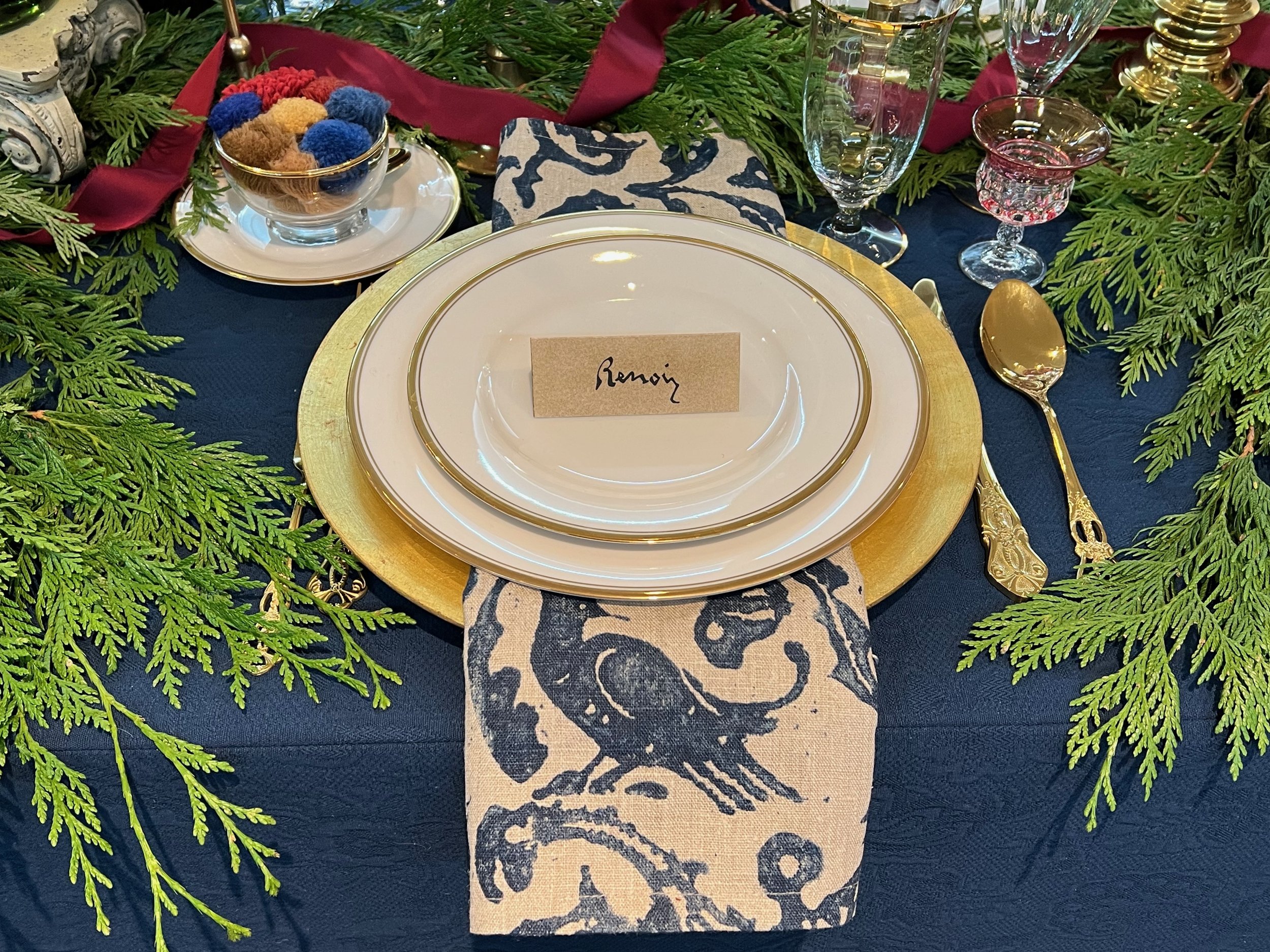
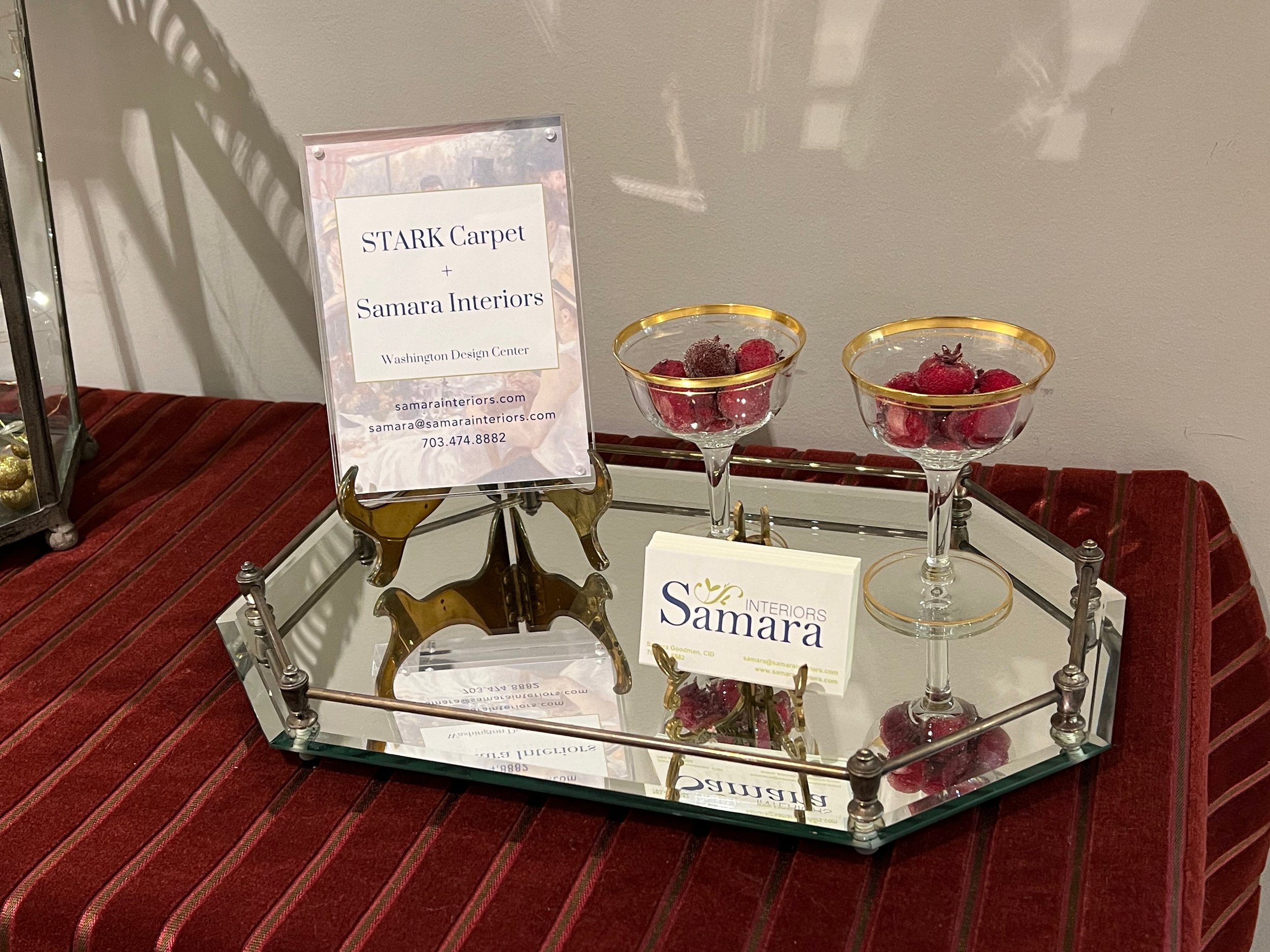
To set the scene, the DC area has been very fortunate to have the exhibition "Paris 1874: The Impressionist Moment" on view at the National Gallery of Art this fall, which Samara saw and loved. This sparked her idea to use the exhibit as the foundation for weaving in the Parisian theme, and to ground the holiday tablescapes in a fun play on another famous French Impressionist painting which also happens to be in DC, Pierre-Auguste Renoir's painting "The Luncheon of the Boating Party," which is in The Phillips Collection. Renoir's color choices in the painting informed the elements Samara wove into the STARK installation, from the blue tablecloth speaking to the blue dresses the women are wearing to the red stripes above them that appear on the table below the mirror. Samara's design concept wittily played on the Boating Party's luncheon, and envisioned that the ghostly guests were now ready to sit down for a beautiful holiday dinner. I adored the STARK poms (used to design the colors in custom carpets) that Samara featured as dessert in the main tablescape, and my favorite part is WHO is coming to dinner... If you look at the photograph of the placecard I've included carefully, you'll get a clue about the identity of the ghostly dinner guests.

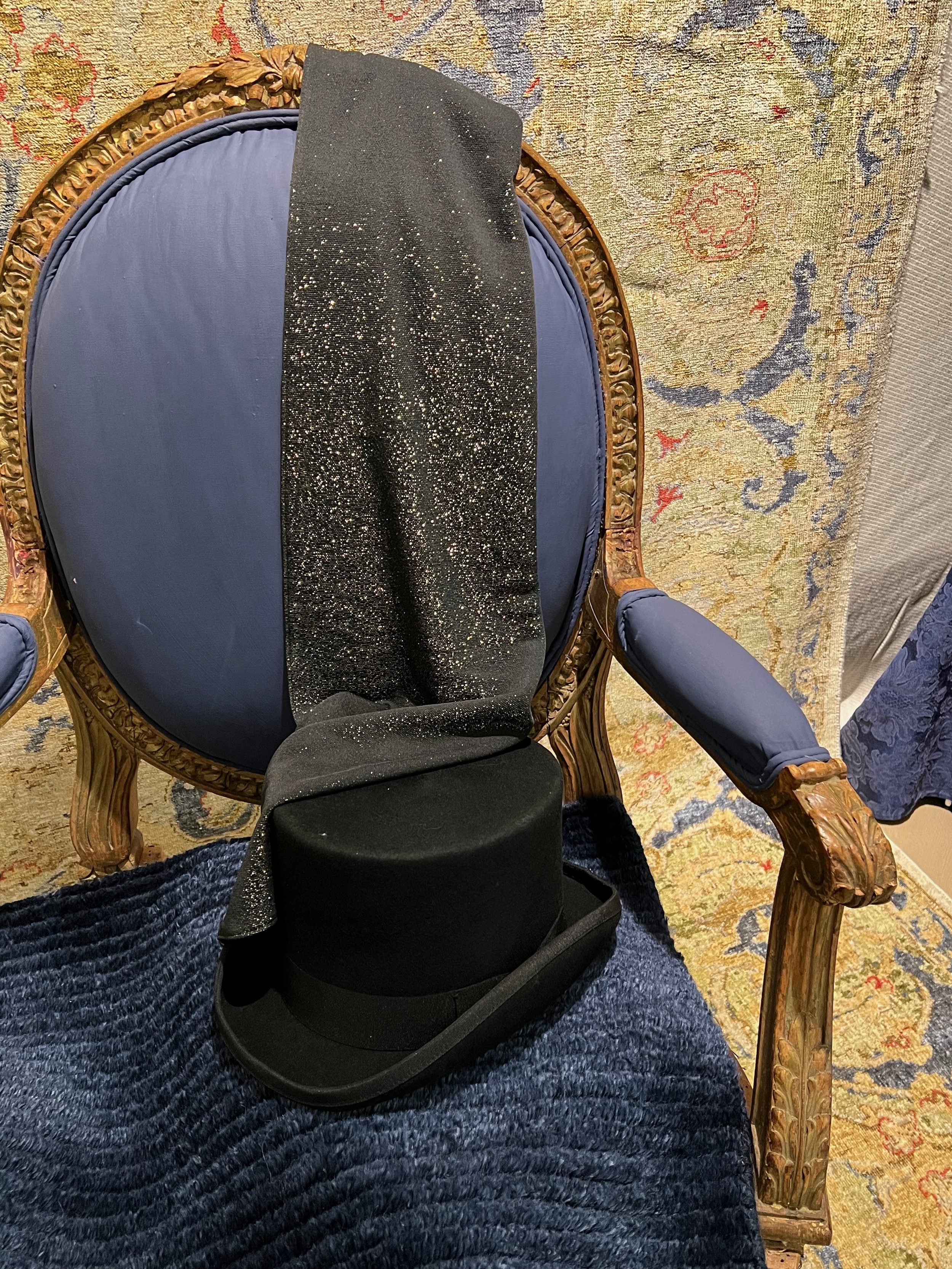
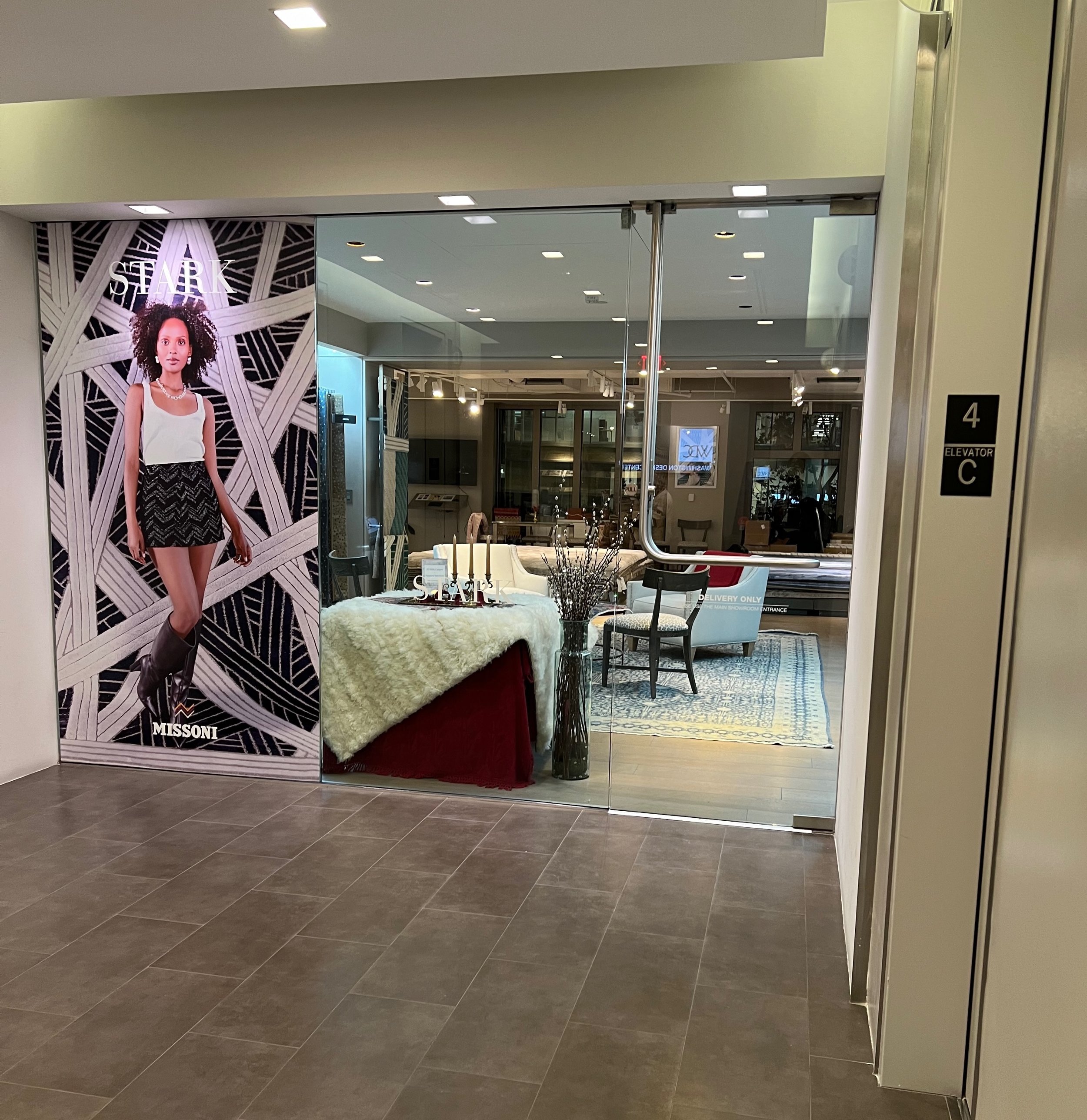
Samara and her design team impressively created a multi-part installation including two displays flanking the front entrance to the showroom: one evoking the visitor's [time] travel back to Victorian Paris with a beautiful STARK rug reminiscent of antique maps and a stack of vintage suitcases featuring an illuminated Eiffel Tower. The second vignette leads visitors through a portal back in time to glimpse a Victorian Parisian couple's evening at the opera, complete with top hat and opera glasses that have been placed on antique chairs awaiting them to return shortly. The artist's dinner party welcomes visitors in the main showroom area, and visible off the elevators is an additional installation Samara created showcasing a beautiful STARK rug in blue tones that accentuates the blue candles in the menorah.

I had the best time meeting the STARK DC team and appreciate how welcoming and friendly they all were. It was a joy to support my friend and witness her design brilliance! Congratulations Samara! (Pictures by me other than my photo by Kaz Sasahara)